
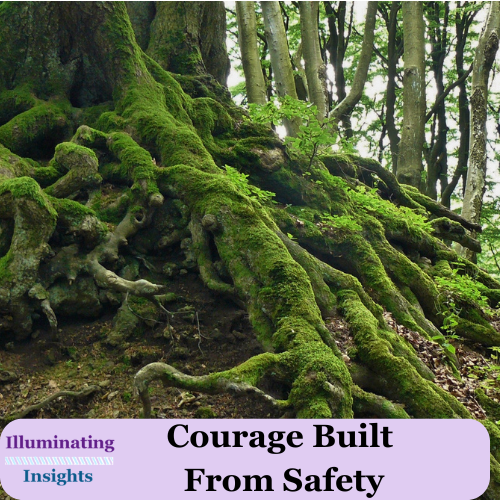
Safety and Courage
Safety and courage are two very important concepts. In our last Community exclusive blogpost, we explored courage as a choice. Now, we want to look at how a sense of safety may be a necessary component to being able to choose courage, particularly in very personal scenarios, like disclosing your deepest pain in order to receive support.
According to Maslow’s Hierarchy of Needs, safety is one of our most basic needs, second only to physiological needs like food and shelter. Our need for safety incorporates things like financial security and psychological safety, which describes not feeling like you will be punished for speaking up with questions or concerns, similar to how a physical sense of safety is feeling like you are unlikely to be harmed. Particularly in the psychological sense, safety requires trust, which can take time to build.
Courage often requires vulnerability, and vulnerability requires exposure in the sense that we need to share of ourselves. The more personal and/or raw the share, the more vulnerable, exposing and courageous it is. In order to allow ourselves to be that open, to expose the personal and raw, we need two things- to take care of ourselves, and to feel a sense of safety. Safety, like trust, can take time to build. So not only does courage require safety, it also means self care, especially after a moment of courage, is important.
Further Resources:
Previous Illuminating Insights blog posts on Choosing Courage (Subscriber Community Exclusive) and Vulnerability & Vulnerability Hangovers
Choosing Courage
I’ve come to think of courage as a choice, especially with all the hardships that can go alongside living with marginalised identity in a world where we’re often excluded and/or overlooked. you could also be forgiven for questioning whether or not it borderlines on toxic positivity. I feel like there’s validity in that, because there is potential to tip into toxic positivity if it’s taken too far.
‘It wasn’t chance or mere luck when someone radiated brightness, it was a very deliberate and conscious act. Staying soft when the world could have made you hard, and keeping your heart open when it wants to close are some of the bravest things a human can do’. This quote from Emma Carey’s memoir immediately struck me because of how strongly it resonated with how I’ve come to think of courage- a choice, especially with all the hardships that can go alongside living with marginalised identity in a world where we’re often excluded and/or overlooked. Reading that quote, you could also be forgiven for questioning whether or not it borderlines on toxic positivity. I feel like there’s validity in that, because there is potential to tip into toxic positivity if it’s taken too far. Another quote Emma Carey’s could be considered in relation to though is this one from The Princess Diaries; ‘Courage is not the absence of fear, but rather the judgement that something else is more important than fear.’ That suggests the choice to be courageous, because the act of courage feels more important than the alternative of not being brave. That’s not to say it’s not scary to move through hardship, challenge or struggle. Courage just means that you try anyway. That trying is courage, as is choosing to trust others with your personal story, or parts thereof. Honouring these everyday acts of courage is the purpose behind why we hold Courage among our values.
We’ve talked about courage being a choice, but that doesn’t mean it’s always necessarily the right choice. Something is courageous for a reason, which also means that when we choose courage, it can take a toll on us. Sometimes that courage may be forced, like sometimes when we have to go out into the world when we’re really not feeling it, or going through the necessary therapies to keep us well. In scenarios like these, forced courage may be necessary, but when it’s forced by way of courage being pushed upon us and demanded of us, then it might tip a little into toxic positivity, which is pressure to exclusively display positivity, at the expense of any negative emotions or negativity someone might be experiencing beneath the surface. Courage is, in a way, a form of positivity, though one that can come at a cost. So if you recognise that you’ve made a courageous choice today, I’d encourage you to firstly take the time to acknowledge it celebrate it and honour it, then, take a step back, a breath and a break to allow yourself to recharge and reset.
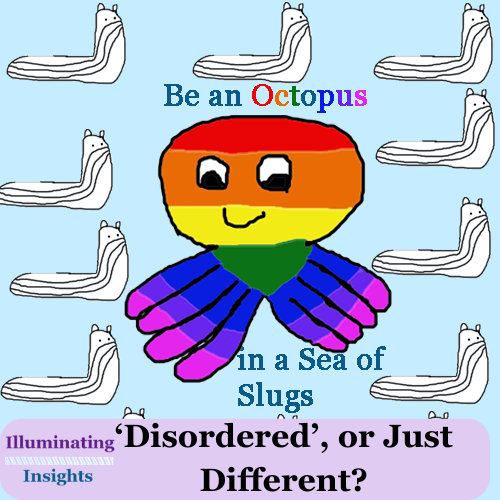
‘Disordered’, Or Just Different?
Many diagnostic acronyms, and thereby, diagnoses, end with ‘D’ for ‘disorder’. Are these things labelled ‘disorders‘ really disorders, or just different ways of being?
Many diagnostic acronyms, and thereby, diagnoses, end with ‘D’ for ‘disorder’. Bipolar Disorder. Autism Spectrum Disorder. But what if we eliminated the ‘D’? What if Bipolar Disorder was just Bipolar and Autism Spectrum Disorder was just Autism Spectrum, or even Autism? Are these things really disorders, or just different ways of being? My first introduction to this idea of ‘disorders‘ possibly just being differences was through an episode of the Listenable podcast with musician Alex the Astronaut in a brief discussion led by Dylan Alcott (more here).
This idea of differences as opposed to disorders is also reflected in the concept of ‘neurodiversity‘, which is described as differences in the way people’s brains work. Neurodiversity encompasses diagnoses including autism, dyspraxia, dyselxia and ADHD (still learning the best way to eliminate the final ‘D‘ from that one). There may be a place for the inclusion of ‘disorder’ that, not being a trained medical professional like a doctor, I am not aware of, though it seems to me that in some ways, ‘disorder’ is a term with a similar definition to disability.
The term ‘disorder‘ in the context of diagnostic labels can sometimes suggest that something is wrong. But is it really wrong, or is it just different to the majority of people? I feel like this is important to consider, because if someone believes a part of them, over which they have no control, like the parts of them affected by disability, for example, are wrong, it can be damaging, particularly when deeply internalised. So perhaps eliminating the extra ‘D‘ in diagnostic labels, even if only for yourself, can go toward reframing the idea that this aspect of you with a diagnostic label is ‘wrong‘ and help reinforce the idea that maybe, it’s not necessarily ‘wrong’, just different to most other people. To put it another way, what if your differences make you kind of like a flamingo in a flock of pigeons? Or an octopus in a sea of slugs?